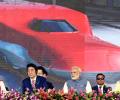
Prime Minister Narendra Modi and his Japanese counterpart Shinzo Abe on Thursday launched India's first bullet train project in Ahmedabad. Here's all you need to know about the project.

United States President Barack Obama will host Japanese Prime Minister Shinzo Abe on Friday in his Oval office - his first with a foreign dignitary in his second term - for bilateral and regional discussions with North Korean nuclear tests and South China sea dominating the proceedings.
On the eve of his visit to Japan, Prime Minister Manmohan Singh spoke to the Japanese media on the agenda of his visit. This is an excerpt

The organisers took the unprecedented step of postponing the Olympics in March because of the pandemic and the government of Prime Minister Yoshihide Suga, who has declared he will host the Olympics "at any cost", is pressing ahead with the preparations.

A series of recent scandals engulfing officials working on the opening ceremony of the Tokyo 2020 Games

Prime Minister Narendra Modi has written to his Japanese counterpart Shinzo Abe about the postponement of his proposed visit there next month in view of the Budget session of the Parliament.
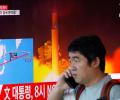
North Korea warns the US that it will soon 'suffer the greatest pain it ever experienced in its history'. Rajaram Panda looks at the latest twist in the North Korean crisis.

Ainu dancers were told there wasn't room to fit the dance into the July 24 performance

The two sides held discussions on enhancing investment in technology, renewable energy and food security.
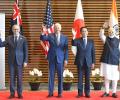
India has the ability in all respects to be a great power and address our security challenges in the best national interests, says Commodore Venugopal Menon (retd).

Simone Biles, the most decorated gymnast in world championship history, said she had returned to the gym this week after about seven or eight weeks away

The PM will pay a two-day visit to Japan from October 28-29 to hold the annual India-Japan summit with Abe. The focus of the visit will be to further expand cooperation in the Indo-Pacific region, carry out joint infrastructure projects in third countries and further boost ties key sectors like defence and trade.

International Olympic Committee (IOC) chief Thomas Bach says the Tokyo Games would have to be scrapped if the event cannot be held next year due to the COVID-19 crisis. In March, the IOC and Japanese government took the unprecedented decision to delay the Games, which had been due to start in July, for a year due to the novel coronavirus outbreak.

Japanese Prime Minister Shinzo Abe's $12-billion loan at an incredibly low interest rate may have trumped China's aim to enter the enormous Indian Railways market, notes A K Bhattacharya.

India and Japan are set to intensify defence cooperation with the two sides likely to launch a security consultative framework involving their foreign and defence ministers.

Japanese Prime Minister Shinzo Abe on Wednesday called for sports and cultural events to be scrapped or curtailed for two weeks as the country battles to stem coronavirus contagion amid mounting concerns the 2020 Tokyo Olympics could be cancelled. Abe's call came after a Tokyo baseball team said it would play games in an empty stadium this weekend, while two businesses in central Tokyo reported confirmed cases of infection a day after the government urged companies to recommend staff consider working from home.

Tokyo Olympics organisers are focusing on their new Games start date in 2021, they stressed on Friday -- even if the coronavirus outbreak complicates preparations for the remade extravaganza. At his first remote news conference on Friday, Tokyo 2020 CEO Toshiro Muto emphasised that Games organisers are aiming towards the new start date of July 23, 2021, regardless of how long it takes to contain the coronavirus outbreak.

The International Olympic Committee (IOC) must give athletes some 'clarity, transparency and flexibility' by postponing the Tokyo Games over the coronavirus pandemic, British athlete Guy Learmonth has said.

US President Donald Trump said on Thursday officials should consider delaying the Tokyo 2020 Olympic Games for one year amid the coronavirus pandemic, saying the summer event would not be the same without spectators. The United States is one of the biggest participants in the Games, scheduled to begin in July and expected to be a major economic boost for Japan.
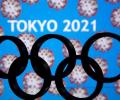
Olympics organisers must replan the Games without running up huge additional costs. IOC President Thomas Bach said his organisation faces several hundred million dollars in supplementary costs.

PM Modi and his Japanese counterpart are likely to sign several agreements, including on civil nuclear cooperation. Both leaders are also likely to discuss defence cooperation, including joint maritime exercises between Japan, India and the United States.
India and Japan are expected to move ahead on signing a comprehensive economic partnership agreement, besides finalising a partnership on the Delhi-Mumbai industrial corridor.
This will serve as framework for Smart heritage city programme between the two countries

Tokyo Governor Yuriko Koike said on Thursday that organisers were looking at ways to simplify the Games.

Trump said it would be tremendous for the world if the meeting went well.

Japan is eager to quell fears the Games might be called off, postponed or moved to a different location due to the virus. And despite its optimism over the Olympics, Japan has cancelled numerous sporting events.
Addressing the MPs in Parliament, he favoured early conclusion of the Comprehensive Economic Partnership Agreement to push economic relations and raise the volume of bilateral trade to $20 billion in the next three years.
The Union Cabinet approved the DMIC project outline on the eve of the visit of Japanese Prime Minister Shinzo Abe, Information and Broadcasting Minister P R Dasmunshi told reporters here.
Agriculture minister Toshikatsu Matsuoka reportedly hanged himself hours before he was to face questioning in parliament over a political scandal.

The vanity project, of absolutely no use to most Indians, will suck money that could be used for health and education, says Aakar Patel.
.jpg)
India and Japan on Monday agreed to enhance their defence and strategic cooperation to a new level during talks between Prime Minister Narendra Modi and his counterpart Shinzo Abe, who also decided to speed up negotiations on civil nuclear deal that could not be concluded now.
During his talks and public speeches, Mukherjee urged Japan to look at India's "impeccable" non-proliferation record and back the Indo-US civilian nuclear agreement at the Nuclear Suppliers Group meeting.
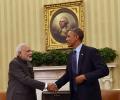
Narendra Modi would have done well to take a few more months before he agreed to receive or call on heads of countries like Japan, China, and the US. The prime minister is to settle down in his job and it was too soon for him to have full awareness of the nuances of intricate international issues, says B S Raghavan.
Prime Minister Manmohan Singh returned to New Delhi on Saturday after a four-day visit to Japan during which he held talks with his Japanese counterpart Shinzo Abe on various issues
That Japan put high marquee value on the prime minister's visit is evident from the fact that Dr Singh has been invited to address a joint session of the Diet, Japanese Parliament.
Why there is a sudden spurt in FTAs is something which needs to be critically looked at.

Here are some top moments from Modi's Kyoto trip.
Japan's changing strategic calculations will hopefully bring money into India. Abe informed the audience that 480 Japanese companies are present in India and Indo-Japan partnership is growing by leaps and bounds
'On the agenda: A nearly $100 billion Delhi-Mumbai fast track freight corridor, a similar corridor for Delhi and Kolkata, cooperation in counter-terrorism and security matters, and civil nuclear cooperation.'

Prime Minister Narendra Modi flew to Tokyo on Sunday for crucial summit talks with his Japanese counterpart Shinzo Abe after an overnight stay in Kyoto where he visited two ancient Buddhist temples with the latter accompanying him in a significant gesture.
 © 2026 Rediff.com - Investor Information - Advertise with us - Disclaimer - Privacy Policy - Sitemap - Feedback - About us - Terms of use - Grievances